Thursday, June 25, 2015

X Error of Failed Request: BadFont (Invalid Font Parameter) in Unix

X Error of failed request:  BadFont (invalid Font parameter)


When I was trying to start WebSphere Developer Studio , faced the with below error. And this is very common error in UNIX. Because , there are many local and international languages.Its basically not able to find the respective font.

dev@jdg-developer-desktop /opt/IBM/WebSphereStudio/ApplicationDeveloper/v5.1.1 $ ./shortcut_wsappdev
Warning: locale not supported by C library, locale unchanged
X Error of failed request:  BadFont (invalid Font parameter)
  Major opcode of failed request:  55 (X_CreateGC)
  Resource id in failed request:  0x0
  Serial number of failed request:  180
  Current serial number in output stream:  184


You need to sure and make the language installed 

sudo apt-get install language-pack-en-base


Now reconfigure some local languages this is of Ubuntu (try with super user):

sudo dpkg-reconfigure locales


Now you can try your local language :

locale -a


Now you can set your expected language as per your requirement. I tried all and set in my Ubuntu Linux machine. It worked for me.

export LC_ALL="en.utf-8"


export LC_ALL="en_US"
export LANG="en_US"
export LANGUAGE="en_NZ"
export C_CTYPE="en_US"
export LC_NUMERIC=
export LC_TIME=en"en_US"

Find more here about locale.

Saturday, June 20, 2015

How to Decompile Java Class Files on Linux and Windows

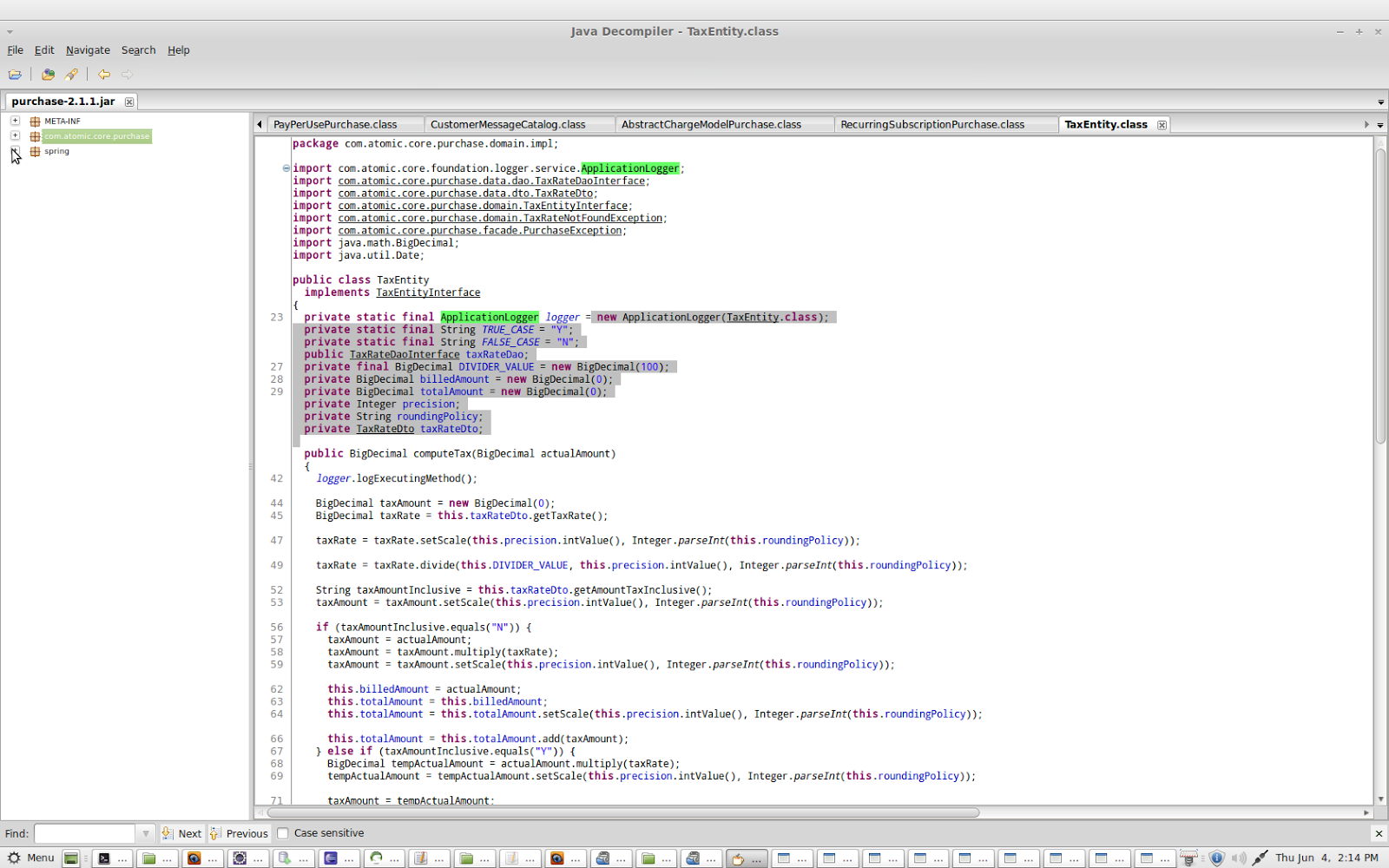
How to install graphical java de-compiler (jd-gui) ?

Really this is very basic and very useful when you want to de compile the existing old legacy code . I faced this kind of situation many times and did the same thing. I am sharing this because it may help you .

I am using Linux (Ubuntu Maya). But, you can try with any other Linux distributions even windows OS also. You need to download the 

Download from here.


You  need to download the.tar.gz file  ( jd-gui-0.3.5.linux.i686.tar.gz) for Linux. Then extract the file and go to jd-gui-0.3.5.linux.i686 folder. You can extact via below command else you can try by right+click on the file and extract.

tar -xvf jd-gui-0.3.5.linux.i686.tar.gz

Check there are such below files in that directory.

 
dev@jdg-developer-desktop ~/Downloads/jd-gui-0.3.5.linux.i686 $ ls -ltr
total 1100
drwx------ 3 dev dev    4096 Aug 29  2012 contrib
-rwxrwxr-x 1 dev dev 1111160 Oct 16  2012 jd-gui
-rw-r--r-- 1 dev dev    2462 Oct 16  2012 readme.txt
-rw-r--r-- 1 dev dev     317 Jun  4 14:15 jd-gui.cfg
dev@jdg-developer-desktop ~/Downloads/jd-gui-0.3.5.linux.i686 $ 

Execute the jd-gui and open the application :
dev@jdg-developer-desktop ~/Downloads/jd-gui-0.3.5.linux.i686 $ ./jd-gui  


You can import multiple jar files for de-compile and see the code.

Note - You may get some kind of library missing error , but it depends on you operating system.Whether you are using Fedora,Mint ,Cent Os or Ubuntu. So, you need to install the respective lib and need to update the OS terminal if required.You need to install the below extra libraries if its asking.

 sudo apt-get install libgtk2.0-0:i386 libxxf86vm1:i386 libsm6:i386 lib32stdc++6
I have fixed in my desktop, because of this missing lib I was getting some kind of library missing error. But you can fix this and TRY........Good Luck.

Thursday, May 28, 2015

How to Convert Epoch Time to Human-Readable Format in Unix

How to convert epoch to human readable format in UNIX ?


In this example the epoch time is 1432783870. Use the below command to convert the epoch time to human readable time.Technically epoch time known as UNIX time , also known as POSIX time. 

Example :-

dev@javadevelopersguide-developer-desktop ~/Epoch/ $ date -d @1432783870
Thu May 28 13:31:10 EST 2015
dev@javadevelopersguide-developer-desktop ~/Epoch/ $ date -d @1377360000
Sun Aug 25 02:00:00 EST 2013

Find more here.


Wednesday, April 29, 2015

Eclipse Main Class Not Found: Troubleshooting Classpath Issues

This is the common issue with Eclipse , even I faced many times . This is not related to Eclipse or any other IDE tool.


This issue occurs when you are trying to run your main() method with respective class, its looking for the exact .class file in the class path.During the execution the .class file is not available in the class path. The best way to resolve this is, add the .class file into class path.

There are many possible diagnosis you can do in your Eclipse for this issue. As per the Eclipse behavior when you are updating the class path (Build Path) , your class is getting compiled that time and the .class file got created. So, Be careful when doing the build path for your project.

Also check your Build Path, if any jar file is missing. Because, its might causes sometime.

In my case I just found the jar file missing in the build path , and I removed the missing jar and added new jar file from other location.Then executed my class with main method and it works. Below screenshot shows my issue.


Tuesday, April 7, 2015

How to Convert String to Date in Java Using Joda-Time

How to convert String to Date in java using Joda Time ?

The below program converts the String-to-Date and Date-to-String using joda time library. Joda Time library is a 3rd party jar and its very easy and compact to use for such conversion. Download the joda jar from https://github.com/JodaOrg/joda-time/releases

Example :-

package jdevelopersguide.lab;

import java.util.Date;
import org.joda.time.DateTime;
import org.joda.time.format.DateTimeFormat;

public class ConvertToDate {

/**
* @param args
*/
public static void main(String[] args) {
String date="2015-04-07";
DateTime jodaTimeDate=DateTimeFormat.forPattern("yyyy-mm-dd").parseDateTime(date);
System.out.println("Joda Time Date is::"+jodaTimeDate);

//Convert Joda DateTime to Java Date
Date javaDate=jodaTimeDate.toDate();
System.out.println("Converted Java Date is:::"+javaDate);

//Convert Java Date to String
String convertedDate=DateTimeFormat.forPattern("dd-mm-yyyy").print(javaDate.getTime());
System.out.println("Converted Java Date to String::::"+convertedDate);
}

}


Output :-


Joda Time Date is::2015-01-07T00:04:00.000+11:00
Converted Java Date is:::Wed Jan 07 00:04:00 EST 2015
Converted Java Date to String::::07-04-2015


The  Pattern is really very simple and you can use as per your requirements. There are many pattens are there as follows :-

The pattern syntax is mostly compatible with java.text.SimpleDateFormat - time zone names cannot be parsed and a few more symbols are supported. All ASCII letters are reserved as pattern letters, which are defined as follows:
 Symbol  Meaning                      Presentation  Examples
 ------  -------                      ------------  -------
 G       era                          text          AD
 C       century of era (>=0)         number        20
 Y       year of era (>=0)            year          1996

 x       weekyear                     year          1996
 w       week of weekyear             number        27
 e       day of week                  number        2
 E       day of week                  text          Tuesday; Tue

 y       year                         year          1996
 D       day of year                  number        189
 M       month of year                month         July; Jul; 07
 d       day of month                 number        10

 a       halfday of day               text          PM
 K       hour of halfday (0~11)       number        0
 h       clockhour of halfday (1~12)  number        12

 H       hour of day (0~23)           number        0
 k       clockhour of day (1~24)      number        24
 m       minute of hour               number        30
 s       second of minute             number        55
 S       fraction of second           number        978

 z       time zone                    text          Pacific Standard Time; PST
 Z       time zone offset/id          zone          -0800; -08:00; America/Los_Angeles

 '       escape for text              delimiter
 ''      single quote                 literal       '
 

You can find more details in joda site

Monday, April 6, 2015

How to Create a Client JAR from WSDL

There are many ways you can create the client.jar for your WSDL file . Using the below process you can create the client jar. But its not recommended to use for live project. For live project you need to create a project with maven structure and I will post that later. This can be used for testing purpose.

Open your linux/unix terminal and follow the steps below.


Step 1- Get the published WSDL.Use wsimport command to get the WSDL file. 

dev@optus-developer-desktop ~/temp/test $ wsimport -keep http://localhost:9001/myapps/TestApp?wsdl

dev@optus-developer-desktop ~/temp/test $ ls -ltr
total 16
drwxr-xr-x 3 dev dev 4096 Apr  5 10:52 au
drwxr-xr-x 3 dev dev 4096 Apr  5 10:52 webservice
drwxr-xr-x 4 dev dev 4096 Apr  5 10:52 org
drwxr-xr-x 3 dev dev 4096 Apr  5 10:52 types


Step 2- Create Jar file using jar command as below.


dev@javadevelopersguide-developer-desktop ~/temp/test $ jar -cvf client.jar .

.....
.....
.....
.....adding: org/javadevelopersguide/apps/com/resource/physicalresourcespec/ObjectFactory.class(in = 1568) (out= 627)(deflated 60%)
adding: org/javadevelopersguide/apps/com/resource/physicalresourcespec/PhysicalResourceSpec.class(in = 1205) (out= 500)(deflated 58%)
adding: org/javadevelopersguide/apps/com/resource/physicalresourcespec/package-info.class(in = 426) (out= 294)(deflated 30%)
adding: org/javadevelopersguide/apps/com/service/(in = 0) (out= 0)(stored 0%)
adding: org/javadevelopersguide/apps/com/service/servicespeccharacteristicvalue/(in = 0) (out= 0)(stored 0%)
adding: org/javadevelopersguide/apps/com/service/servicespeccharacteristicvalue/ServiceSpecCharacteristicValue.class(in = 1705) (out= 717)(deflated 57%)
adding: org/javadevelopersguide/apps/com/service/servicespeccharacteristicvalue/package-info.java(in = 289) (out= 199)(deflated 31%)
adding: org/javadevelopersguide/apps/com/service/servicespeccharacteristicvalue/ServiceSpecCharacteristicValue.java(in = 5228) (out= 855)(deflated 83%)
adding: org/javadevelopersguide/apps/com/service/servicespeccharacteristicvalue/ObjectFactory.java(in = 2190) (out= 705)(deflated 67%)
adding: org/javadevelopersguide/apps/com/service/servicespeccharacteristicvalue/ObjectFactory.class(in = 1711) (out= 639)(deflated 62%)
adding: org/javadevelopersguide/apps/com/service/servicespeccharacteristicvalue/package-info.class(in = 444) (out= 303)(deflated 31%)
adding: org/javadevelopersguide/apps/com/service/servicespeccharacteristic/(in = 0) (out= 0)(stored 0%)
adding: org/javadevelopersguide/apps/com/service/servicespeccharacteristic/ServiceSpecCharacteristic.java(in = 8623) (out= 1656)(deflated 80%)
adding: org/javadevelopersguide/apps/com/service/servicespeccharacteristic/package-info.java(in = 279) (out= 193)(deflated 30%)
adding: org/javadevelopersguide/apps/com/service/servicespeccharacteristic/ServiceSpecCharacteristic.class(in = 2805) (out= 1068)(deflated 61%)
adding: org/javadevelopersguide/apps/com/service/servicespeccharacteristic/ObjectFactory.java(in = 2095) (out= 695)(deflated 66%)
adding: org/javadevelopersguide/apps/com/service/servicespeccharacteristic/ObjectFactory.class(in = 1636) (out= 630)(deflated 61%)
adding: org/javadevelopersguide/apps/com/service/servicespeccharacteristic/package-info.class(in = 434) (out= 297)(deflated 31%)
...........
...........
...........
...........


dev@javadevelopersguide-developer-desktop ~/temp/test $ ls -ltr
total 1356
drwxr-xr-x 3 dev dev 4096 Apr 5 10:52 au
drwxr-xr-x 3 dev dev 4096 Apr 5 10:52 webservice
drwxr-xr-x 4 dev dev 4096 Apr 5 10:52 org
drwxr-xr-x 3 dev dev 4096 Apr 5 10:52 types
-rw-r--r-- 1 dev dev 1369704 Apr 5 10:56 client.jar


Now the client.jar is got generated, you can use this jar file and call the real published service.


Hope it will help you.


Wednesday, February 11, 2015

Sapient Interview Questions and Answers for Java 2 - 6 Year Experience

Sapient Interview questions for Java experience candidate - 2 -6 years.....

Q1) Tell me about yourself!!!

Ans – Give your brief introduction with full confidence.

Q2) What are the types of class loaders in Java ?

Ans –

 Q3)  How to read and write image from a file ?

Ans – By the use of ImageIO.read() and ImageIO.write()  method of javax.imageio package.

 Q4) What is difference between static and init block in Java ?

Ans –

Q5) What is ConcurrentMap and how it works?

Ans – It’s a Map which providing thread safety and atomicity guarantees. For Memory consistency it works with other concurrent collections, actions in a thread prior to placing an object into a ConcurrentMap as a key or value happen-before actions subsequent to the access or removal of that object from the ConcurrentMap in another thread.

       Q6) Can a static block throw exception?

Ans –  Yes. We can throw checked exception.

Q7) What is difference between iterator access and index access?

Ans - Basically iterator access process the traverse operation through each element, where index access process access direct the element by using the index.

Q8) Why character array is better than string for storing password in Java?

Ans – Security !!! Because, character array stores data in encrypted format which is not readable by human. But, the string stores the data in human readable format which is not secure.

Q9) What is the difference between Serializable and Externalizable interfaces ?

Ans - Both interfaces are used for implement serialization. But, the basic
difference is Serializable interface does not have any method (it’s a
marker interface ) and Externalizable interface having 2 methods such as
 readExternal() and writeExternal(). Serializable interface is the super
interface for Externalizable interface. 

 Q10)   Which Interface is used to make duplicate of Objects ?

Ans – Cloneable interface.

 Q11) What are some advantages and disadvantages of Java Sockets?

Ans – The main advantage is its flexible and very efficient during low network bandwidth. Also its helpful for debugging and some kind of testing. But, security is the most disadvantages. Its always recommended to be careful when authenticating.

Q12)  When can an object reference be cast to an interface reference?

Ans –Yes its possible, when that interface is implemented by that class.

Example – MyInterface obj=new MyClass();
                obj.callMethod();

Q13)  How does Java allocate stack and heap Memory?

Ans – As we know stack memory is not dynamic and its follows LIFO order. Java provides similar implementation for memory allocation. Normally all local variables are created in Stack area (memory) and objects (reference types) are created in heap memory (heap area) .Even all primitive types allocated in stack memory. Heap area is dynamic and handled by JVM runtime. Heap memory is cleaned by garbage collector at runtime.

Q14)   What is memory leak in Java?


Ans – Usually memory leak leads to waste of memory. In general memory leak defines the unavailability of referenced memory. It causes the Garbage collector to fail to collect that object.

Q15) Can we throw exception from finally block in Java?

Ans – Yes, but you need to mentioned “throws” on the method head.

Example
        
public static void main(String[] args) throws Exception {
// TODO Auto-generated method stub
TestInterface2 interObj=new InterfaceObject();

try{
interObj.display();
}catch(Exception e){
System.out.println("Exception handled...");
}finally{
throw new Exception("This is exception");
}
}

Q16)  How does Java handle integer overflows and underflows?

Ans – Yes, java handles overflows and underflows very intelligently. When it overflows it will go to MIN_VALUE (i.e. -231 ) and when it underflows to will go to MAX_VALUE (i.e. 231-1) .

Q18)  What is casting?

Ans – Casting means conversion. Basically we need casting to type cast the type. There are two types of casting by java i.e. explicit casting and implicit casting.

Q19)  What is new in JSP?

Ans – As per my knowledge JSP 2.1 has many new functionalities. It support resource injection via annotation. It has few extended support for java standard tag library. Also literal expression is supported by JSP 2.1 EL  and many other additional features.

Q20) What do you mean by Java Reflection ?

Ans – It provides runtime access to JVM.  Reflection is one of the most powerful API  which help to work with classes, methods and variables dynamically at runtime. Basically it inspects the class attributes at runtime. Also we can say it provides a metadata about the class. 

Q21) Why does the InputStreamReader class has a read() ?

Ans – Because, an InputStreamReader is a bridge from byte streams to character streams: It reads bytes and decodes them into characters using a specified charset. The charset that it uses may be specified by name or may be given explicitly, or the platform's default charset may be accepted.  It has two overloaded read() method . Each invocation of one of an InputStreamReader's read() methods may cause one or more bytes to be read from the underlying byte-input stream. To enable the efficient conversion of bytes to characters, more bytes may be read ahead from the underlying stream than are necessary to satisfy the current read operation.

Q22)   Describe a problem you faced and how did you solve that?

           Ans  - You can describe any issue you faced during your project work in the                          organization. And what the solution you have implemented for that issue.